release:
Salesforce CLM: Streamlining contract lifecycle management in your business

Contract lifecycle management (CLM) software helps organizations handle contracts from creation to renewal in an organized and efficient way. It ensures that contracts move smoothly through each stage, from drafting and review to approval, execution, and monitoring for compliance and renewal. By centralizing contracts, CLM software reduces errors, improves visibility across teams, and helps businesses manage risk while saving time.
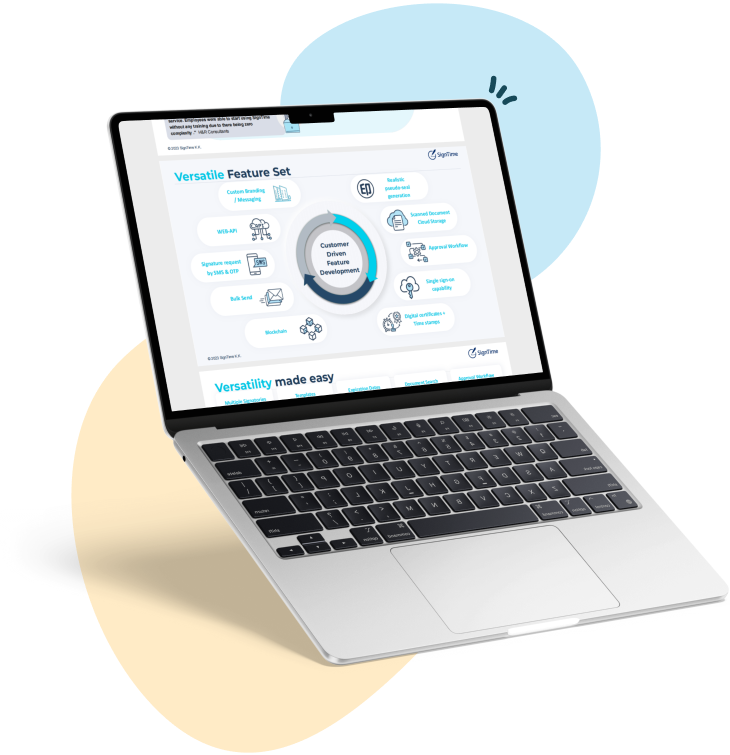
See why businesses are rushing to SignTime’s feature-packed contract repository system.
What is contract lifecycle management software
Contract lifecycle management software is a system designed to oversee every stage of a contract’s life. It tracks the contract from initial creation, through negotiation and approval, to execution and eventual renewal or expiration. This type of software provides tools that simplify collaboration between teams, enforce standard processes, and maintain a clear audit trail of actions taken on each contract.
CLM software is valuable because it standardizes how contracts are created and managed. Instead of relying on emails, spreadsheets, and disconnected systems, teams can centralize information and ensure everyone works from the same version of a document. It also enables organizations to identify bottlenecks, reduce manual errors, and comply with regulatory requirements more effectively.
The main stages covered by contract lifecycle management software include creation, review, negotiation, approval, execution, and renewal. Each stage is supported with specific tools such as templates, workflow automation, electronic signatures, and alerts to track key dates. By integrating these stages, CLM software ensures that contracts progress efficiently while maintaining accountability and transparency.
What is a customer relationship management system?
A customer relationship management (CRM) system is software designed to manage an organization’s interactions with current and potential customers. It helps teams track leads, opportunities, and accounts while centralizing all customer-related information in one place. By organizing this data, a CRM system enables businesses to improve customer relationships, increase sales efficiency, and make data-driven decisions.
Salesforce is one of the leading CRM platforms, widely used by businesses to manage sales pipelines, account information, and customer communications. It provides tools for tracking opportunities, automating follow-ups, and generating reports that give insight into sales performance. While Salesforce includes basic contract management features, it is primarily focused on customer data and sales processes rather than end-to-end contract lifecycle management.
Using a CRM alone to manage contracts can create challenges. Teams may struggle with version control, inconsistent workflows, and limited visibility into approvals and renewals. Integrating a dedicated CLM system with Salesforce helps bridge these gaps, providing a centralized platform for both customer data and contract management.
Why should you integrate your CLM and CRM?
Integrating a contract lifecycle management system with a customer relationship management platform connects contract data with customer information. This integration ensures that teams have a complete view of each customer relationship and the contracts associated with it. By combining these systems, organizations can streamline workflows, reduce errors, and improve collaboration between sales, legal, and operations teams.
When CLM and CRM systems work together, businesses benefit from greater efficiency, faster approvals, and more accurate reporting. Teams no longer need to manually transfer information between systems, which reduces the risk of mistakes and delays. The integration also enables automated reminders for key contract dates, improving compliance and preventing missed deadlines.
Here are some of the benefits of integrating your CLM with Salesforce:
- Efficiency: Integration reduces manual data entry and repetitive tasks.
- Accuracy: Centralized data minimizes errors in contracts and customer records.
- Visibility: Teams can track contract progress alongside customer interactions.
- Compliance: Automated alerts ensure contractual obligations and renewals are monitored.
- Collaboration: Sales, legal, and operations teams can work together seamlessly.
- Faster approvals: Workflow automation speeds up review and signing.
- Risk mitigation: Early detection of inconsistencies or missing approvals.
- Enhanced reporting: Real-time dashboards provide actionable insights.
- Document organization: Centralized repository ensures easy access to all contracts.
- Reduced cycle times: Contracts move faster from creation to execution.
- Audit readiness: Automatic logs simplify compliance checks.
- Customer satisfaction: Quicker contract turnaround improves client experience.
What should companies look for in integrated CLM software
When selecting a CLM system to integrate with Salesforce, companies need to evaluate features that ensure efficiency, compliance, and ease of use. A strong integrated solution supports teams throughout the entire contract lifecycle, reduces manual effort, and provides clear insights into contract performance. The right CLM system enhances collaboration, improves accuracy, and helps businesses scale their processes globally.
Here are the key features to consider in integrated CLM software:
- AI-powered insights: Automatically extract contract terms, dates, and parties to reduce manual review.
- Multi-format e-signatures: Support typed, hand-drawn, hanko, and in-person signatures to meet user preferences and legal requirements.
- Workflow automation: Customizable approval chains streamline contract review and execution across teams.
- Centralized repository: Store all contract types securely in a single location for easy access and organization.
- Role-based access: Control who can view, edit, or approve contracts to maintain security and compliance.
- Automated reminders: Receive notifications for renewals, deadlines, and expirations to prevent missed obligations.
- Audit trails: Track all actions and changes made to contracts for transparency and compliance.
- Reporting and analytics: Generate real-time insights into contract performance and team efficiency.
- Template management: Standardize contract creation to save time and reduce errors.
- Compliance monitoring: Ensure adherence to internal policies and external regulations.
- Collaboration tools: Enable multiple teams to edit, comment, and approve contracts simultaneously.
Future considerations for CLM and CRM integration
As businesses grow, the requirements for CLM and CRM integration evolve. Organizations should consider solutions that scale with their teams, support global operations, and leverage emerging technologies to improve contract management. Future-ready systems incorporate automation, AI, and flexible signing options to meet diverse business needs.
Trends to consider include AI-driven contract analysis, which can automatically identify key dates, obligations, and potential risks. Multi-format e-signature options, including in-person signing, are becoming increasingly important for industries with varied legal requirements. Integration platforms that can handle complex workflows across departments and geographies ensure that businesses maintain efficiency as they expand.
Investing in a system that adapts to future business needs helps companies reduce manual effort, improve compliance, and increase the overall speed and accuracy of contract management. By planning for scalability and technology adoption, organizations can maximize the benefits of CLM and CRM integration over time.
SignTime has the best Salesforce CLM integration
Integrating a contract lifecycle management system with Salesforce is critical for businesses looking to streamline workflows, improve accuracy, and maintain visibility across teams. SignTime offers a solution that combines AI-powered contract insights, flexible e-signatures, and comprehensive workflow automation to support modern contract management needs.
SignTime’s features make it easy to manage contracts from creation to renewal while keeping customer data synchronized in Salesforce. Users can choose from multiple signature formats, including hand-drawn, typed, hanko, and in-person signing, ensuring flexibility across teams and industries. AI-driven tools automatically identify key contract information, track renewals, and provide reminders for critical dates, helping organizations stay compliant and efficient.
By integrating SignTime with Salesforce, businesses can improve collaboration between sales, legal, and operations teams, reduce manual work, and gain better visibility into their contracts. SignTime provides a practical, feature-rich solution that simplifies contract management while supporting the needs of both growing and established organizations.
Download our brochure to see whether SignTime might be a fit for your organization.