release:
HelloSign vs DocuSign: Which is better?

Choosing the right e-signature platform affects how quickly contracts move from draft to signed agreement. HelloSign and DocuSign are both well-known options, but they serve different types of organizations. HelloSign focuses on simplicity and ease of use, while DocuSign offers a broader feature set designed for complex and highly regulated environments.
The choice is not only about recognition or price. It is about how well a platform fits your workflow, integrates with your existing tools, and supports long-term contract management. Some teams need a straightforward signing experience, while others require approval processes, audit controls, and centralized contract storage.
See why businesses are rushing to SignTime’s feature-packed contract repository system.
What is an e-signature?
An e-signature is a digital way to show agreement to the terms of a document. It replaces the need to print, sign by hand, and scan or mail paperwork. This allows contracts to be completed more quickly and with fewer manual steps.
Most e-signature platforms support several ways to sign. These often include typed signatures, drawn signatures, or uploaded images of handwritten signatures. SignTime also supports hanko and hand-written signatures, which are commonly used in Japanese business settings. Each signature is recorded with time and identity data to support verification.
E-signatures enable remote work and cross-border collaboration. Parties can review and sign documents from different locations without delays. This makes them well suited for modern businesses that rely on digital workflows and distributed teams.
What is an online contract repository?
An online contract repository is a secure system for storing and managing contracts in one central location. Instead of keeping agreements in email threads or shared folders, organizations use repositories to maintain a clear and structured record of all contracts. This improves visibility and reduces the risk of misplaced documents.
These repositories often include search and filtering tools that help users locate contracts quickly. Version tracking allows teams to see changes over time, and access controls ensure that only authorized users can view or edit sensitive documents. This is especially important for organizations handling large volumes of agreements.
A contract repository also supports better oversight and planning. Renewal reminders, expiration alerts, and audit logs help teams stay compliant and avoid missed deadlines. When combined with e-signature tools, repositories become a core part of efficient contract management.
What are the benefits of a digital signature and contract management platform?
A digital signature and contract management platform brings signing, storage, and workflow tools into a single system. This reduces the time and effort required to prepare, send, and complete agreements. Teams spend less time on manual tasks and more time on meaningful work.
These platforms also improve security and accuracy. Features such as encryption, audit trails, and permission controls help protect sensitive information. Approval workflows ensure that contracts follow the correct review steps before they are signed, reducing errors and compliance risks.
Centralized contract storage makes it easier to manage documents over time. Users can quickly search for agreements, track their status, and receive reminders for renewals or expirations. This creates greater transparency and helps organizations stay organized as they grow.
What are some popular e-signature platforms?
Many organizations use dedicated e-signature platforms to simplify how contracts are created, signed, and managed. These tools vary in complexity, pricing, and feature depth, making them suitable for different business sizes and workflows.
Here are three popular e-signature platforms:
- SignTime
- HelloSign
- DocuSign
SignTime
SignTime is an e-signature and contract management platform built for both global use and the Japanese market. It supports hanko, hand-written, and typed signatures, giving users flexibility based on business or cultural requirements. The platform integrates with Salesforce, supports SMS notifications, and includes approval workflows that help teams manage contracts from start to finish.
In addition to signing, SignTime provides a secure contract repository with built-in templates and document tracking. These features help organizations centralize agreements, maintain visibility, and reduce administrative overhead. This makes SignTime suitable for teams that need more than basic signing tools.
HelloSign
HelloSign, now part of Dropbox, is known for its clean interface and ease of use. It is designed to help small and mid-sized teams collect signatures quickly without complex setup. The platform integrates well with Dropbox storage, making it convenient for organizations already using that ecosystem.
HelloSign focuses on core e-signature functionality such as templates and basic workflows. While it supports common signing needs, it offers fewer advanced contract management and approval features compared to more comprehensive platforms.
DocuSign
DocuSign is one of the most widely recognized e-signature platforms worldwide. It offers a broad range of features, integrations, and compliance options designed for larger organizations and regulated industries. Many enterprises choose DocuSign for its scalability and extensive configuration options.
The platform supports complex workflows, detailed audit trails, and global compliance standards. However, this depth can also introduce higher costs and added complexity for teams that only need straightforward signing and contract management.
HelloSign vs DocuSign vs SignTime
HelloSign, DocuSign, and SignTime all provide secure and legally recognized e-signature solutions. Each platform addresses a different set of priorities. HelloSign emphasizes simplicity, DocuSign focuses on enterprise-scale compliance and configuration, and SignTime aims to balance flexibility, usability, and contract management depth.
For organizations choosing between these platforms, the differences often come down to workflow support, integrations, and long-term contract oversight. Some teams need fast, basic signing, while others require approval processes, centralized repositories, and support for international or Japan-specific business practices.
The table below compares key features across all three platforms, with a focus on areas that matter most for growing and globally minded organizations.
| Feature | SignTime | HelloSign | DocuSign |
| Salesforce integration | Yes | No | Yes |
| SMS notifications | Yes | No | No |
| Approval workflows | Yes | No | Limited |
| Signature types | Hanko, Hand-written, Typed | Typed, Drawn, Upload | Typed, Drawn, Upload |
| Japanese market support | Yes | No | No |
| Contract repository | Full featured | Basic | Advanced |
| Document templates | Built-in | Built-in | Built-in |
| Supported file types | Many | Common | Many |
| Contract vault security | High | Medium | Medium |
| Free tier | Yes | Yes | No |
| API access | Yes | Yes | Yes |
| Mobile support | Yes | Yes | Yes |
| Bulk sending | Yes | Limited | Yes |
| Audit trails | Detailed | Standard | Detailed |
| CRM integrations | Salesforce plus others | Limited | Multiple |
| Workflow automation | Yes | No | Limited |
| Contract reminders | Yes | No | Yes |
| Compliance scope | Japanese and Global | Global | Global |
| Multi-language support | Yes | Yes | Yes |
| Pricing complexity | Flexible | Simple | Complex |
SignTime is the best contract management platform
SignTime brings together powerful signing options and deep contract management tools in one platform. Its support for hanko, hand-written, and typed signatures gives businesses flexibility that simple e-signature tools do not provide. Salesforce integration and SMS notifications help teams stay connected to their workflows without extra steps.
SignTime also includes approval workflows and a secure contract repository with built-in templates. These features help organizations manage contracts from creation to storage in a central place. This reduces manual work, improves visibility, and helps teams avoid missed deadlines.
Whether you are a small team or a large enterprise with global needs, SignTime provides a reliable, flexible, and cost-effective solution. Try SignTime today to see how modern contract management can work for your organization.
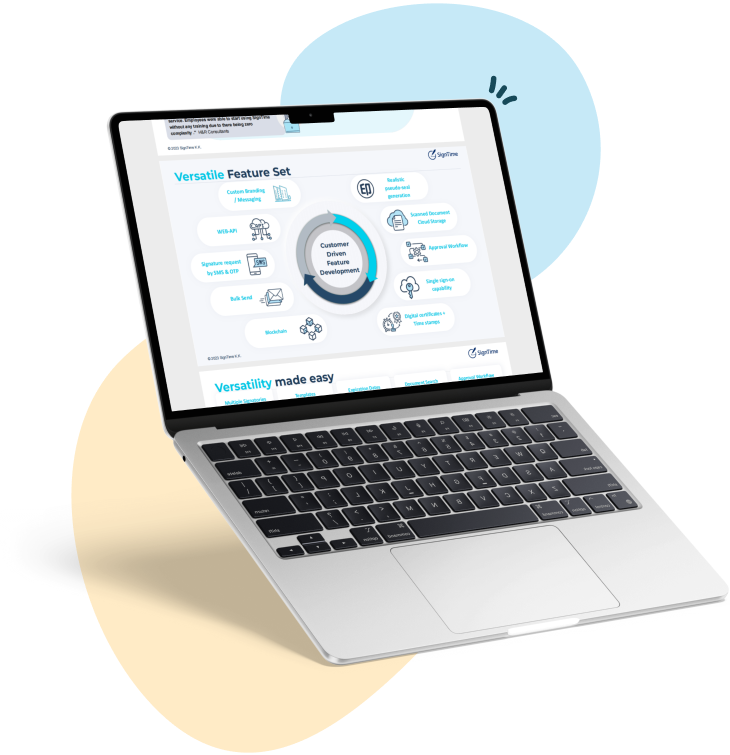
Download our brochure to see whether SignTime might be a fit for your organization.