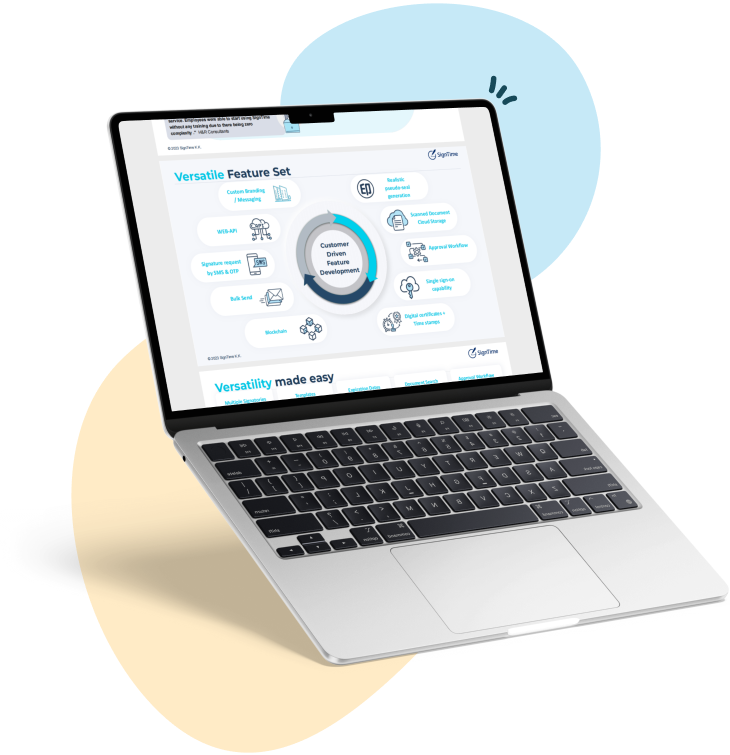
release:
15 contract KPIs you should track
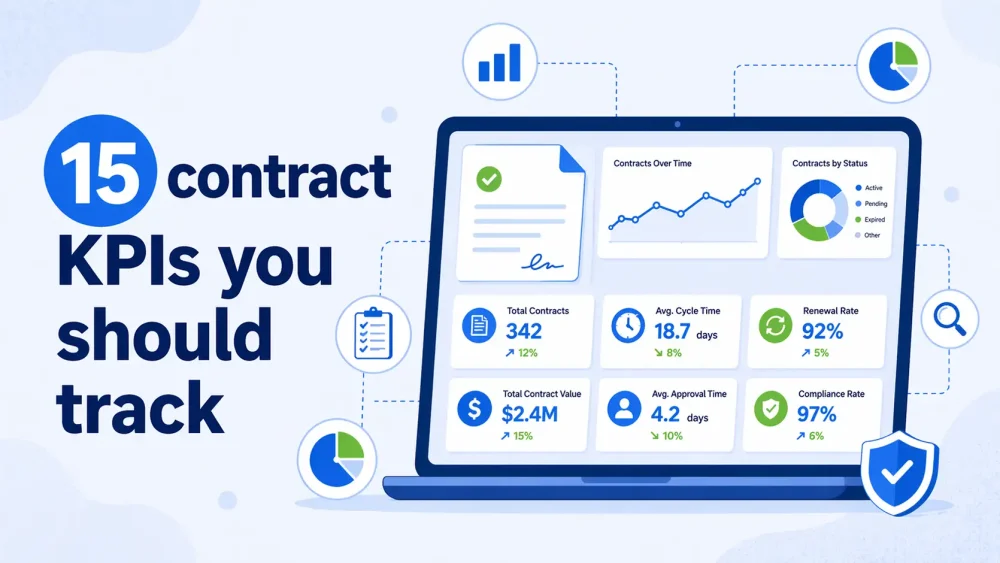
Tracking the right key performance indicators (KPIs) in your contracts is essential for improving efficiency, reducing risk, and maximizing value from every agreement. These KPIs help organizations monitor contract performance, identify bottlenecks, ensure compliance, and maintain strong relationships with counterparties. In this article, we will explore 15 contract KPIs you should track, explain how to calculate them, where to find the data, and provide tips to improve each metric so your contracts work harder for your business.
See why businesses are rushing to SignTime’s feature-packed contract repository system.
What is contract analytics?
Contract analytics is the process of collecting, organizing, and analyzing data from contracts to make better business decisions. It transforms raw contract information into insights that help companies manage risk, improve efficiency, and ensure compliance.
By examining patterns in contract data, organizations can identify bottlenecks, track obligations, and measure the effectiveness of contract processes. Analytics can also highlight opportunities to improve contract performance and reduce costs.
Modern contract management systems often include dashboards and AI tools that automate the extraction of key data points. These tools make it easier to track KPIs such as cycle times, renewal rates, and obligation fulfillment, giving teams actionable insights without manual effort.
Why do companies track contract KPIs?
Companies track contract KPIs to improve operational efficiency, reduce risk, and ensure contracts deliver the intended value. Monitoring these metrics helps identify issues early, supports compliance, and provides insights that guide better decision-making across teams.
Here are some benefits to tracking contract metrics:
- KPIs help organizations identify contracts at risk of missed obligations or late renewals.
- They support compliance with internal policies and external regulations.
- Metrics reveal trends in contract cycle times and negotiation efficiency.
- KPIs measure the financial impact of contracts, including missed revenue or cost savings.
- Tracking these metrics improves collaboration across legal, procurement, and sales teams.
15 contract KPIs you should track
Monitoring the right contract KPIs helps organizations understand how well their agreements are performing across the entire lifecycle. These metrics cover operational efficiency, financial performance, compliance, and risk management.
HEre are the contract metrics you need to monitor:
- Contract cycle time
- Contract renewal rate
- Contract value/financial performance
- Compliance rate
- Risk exposure/risk assessment
- Obligation fulfillment
- Missed milestones/deadline adherence
- Counterparty performance
- Contract repository accuracy
- Dispute frequency/issue count
- Contract volume
- Average time to close/approval
- Acceptance rate/signature completion
- Auto-renewal tracking/renewal alerts
- Value leakage/missed revenue
The following sections break down these 15 key contract KPIs, explain how to calculate them, where to find the data, why it matters, and provide tips to improve results.
Contract cycle time
Contract cycle time measures the duration from when a contract is first created to when it is fully executed. It is calculated by tracking the number of days from the initial draft to the final signature. Most data can be found in a contract management system or CRM that logs contract events.
This KPI matters because shorter cycle times improve operational efficiency and speed up revenue recognition. Long cycles often indicate bottlenecks in approval or negotiation processes, which can delay business outcomes.
To improve contract cycle time, use standardized templates, automate approval workflows, and set reminders for pending reviews. AI tools can help identify contracts that are taking longer than average and suggest where action is needed.
Contract renewal rate
Contract renewal rate measures the percentage of contracts that are renewed on time. It is calculated by dividing the number of contracts renewed by the number of contracts eligible for renewal during a period. The data is usually available from the contract repository or CRM system.
Tracking this KPI is important because it reflects customer and supplier retention and helps forecast recurring revenue. Low renewal rates may indicate dissatisfaction, missed deadlines, or poorly structured contracts.
To improve renewal rates, set proactive reminders before contracts expire, communicate clearly with counterparties, and review terms to ensure they remain favorable. Using AI alerts for upcoming renewals can help prevent contracts from lapsing unnoticed.
Contract value/financial performance
Contract value measures the total monetary value of a contract, including recurring revenue and one-time fees. It can be calculated by summing all payments, fees, and expected revenue outlined in the agreement. Financial performance can also include tracking discounts, amendments, or early terminations.
This KPI is critical for forecasting revenue, managing budgets, and prioritizing high-value agreements. Monitoring contract value also helps identify trends in profitability and potential missed revenue opportunities.
To improve performance, ensure accurate data entry, track milestone payments, and regularly audit contracts to confirm all expected payments are being collected. AI tools can assist in flagging contracts with unfulfilled financial obligations.
Compliance rate
Compliance rate tracks the percentage of contracts that meet internal and external requirements. It is calculated by comparing the number of compliant contracts to the total number of contracts reviewed. The data comes from audits, legal reviews, or automated compliance checks in the contract management system.
This KPI is important because non-compliance can lead to financial penalties, legal disputes, and operational risk. High compliance rates demonstrate effective contract governance and risk management.
To improve compliance, standardize clauses across agreements, automate reminders for key obligations, and leverage AI to flag missing or unusual terms. Regular training for contract teams also reinforces compliance best practices.
Risk exposure/risk assessment
Risk exposure evaluates potential financial, legal, or operational risks in contracts. It can be measured by assigning a risk score based on factors such as counterparty reliability, contract complexity, and monetary value. Data is often drawn from the contract repository and risk management tools.
This KPI matters because it helps organizations prioritize attention on contracts that could lead to disputes, losses, or regulatory issues. High-risk contracts may require additional monitoring or mitigation strategies.
To reduce risk exposure, implement standardized clauses, maintain clear documentation, and use AI to highlight unusual terms or potential red flags. Regular risk reviews ensure new contracts are evaluated consistently.
Obligation fulfillment
Obligation fulfillment measures whether all contractual obligations, such as deliverables, payments, or reporting requirements, are completed on time. It is calculated by comparing completed obligations to total obligations. Most contract management systems track this automatically.
This KPI is important because unfulfilled obligations can harm relationships, lead to penalties, or create missed business opportunities. High fulfillment rates indicate well-managed contracts and strong operational performance.
To improve this metric, automate reminders for upcoming obligations, maintain clear timelines within contracts, and use dashboards to track completion status in real time.
Missed milestones/deadline adherence
Missed milestones tracks the number of deadlines, deliverables, or approvals that are not completed on schedule. It is calculated by comparing the planned completion dates to actual completion dates. Data comes from project tracking or contract management tools.
This KPI matters because delays can disrupt operations, affect revenue, or damage trust with counterparties. Identifying trends in missed milestones helps teams take corrective action.
To improve adherence, set alerts for approaching deadlines, use project management integration, and assign accountability for each milestone. AI can flag contracts at risk of missing milestones based on past performance.
Counterparty performance
Counterparty performance evaluates how well the other party fulfills their contractual obligations. Metrics include delivery times, compliance, and responsiveness to issues. Data is drawn from the contract repository, audits, and CRM systems.
Monitoring this KPI is important because it helps organizations identify reliable partners and flag underperforming ones. Poor counterparty performance can increase risk and reduce the value of contracts.
To improve outcomes, track performance trends over time, document issues promptly, and consider contract terms that incentivize timely performance. AI tools can automatically highlight deviations from expected performance.
Contract repository accuracy
Contract repository accuracy measures how complete and correct the organization’s contract database is. It can be calculated by auditing entries for completeness, correct metadata, and version control.
This KPI matters because a reliable repository ensures teams can make informed decisions quickly. Errors or missing data can lead to missed obligations, inaccurate reporting, and operational inefficiencies.
To improve accuracy, implement standardized data entry practices, conduct regular audits, and leverage AI indexing to automatically verify information.
Dispute frequency/issue count
Dispute frequency tracks the number of contractual disputes or issues within a given period. Data comes from legal logs, issue tracking systems, or the contract management platform.
This KPI is important because frequent disputes indicate problem areas in contracts, unclear terms, or poor execution. Tracking disputes helps organizations reduce risk and refine processes.
To reduce disputes, clarify obligations during contract creation, monitor performance regularly, and use AI to identify potentially problematic clauses before they cause issues.
Contract volume
Contract volume measures the total number of active contracts, often broken down by type, department, or region. Data comes directly from the contract repository or CRM.
This KPI is important because it helps teams allocate resources, manage workloads, and prioritize contracts with higher business impact. High volumes may indicate a need for process automation.
To manage volume effectively, implement organized workflows, automate routine approvals, and track active versus inactive contracts.
Average time to close/approval
Average time to close tracks how long it takes for a contract to move from draft to fully executed, including all approvals. It is calculated by averaging the duration across all contracts in a period. Data comes from the contract management system.
This KPI is important because faster approvals reduce delays and improve operational efficiency. Long approval times may indicate bottlenecks or unclear processes.
To improve this metric, automate approval routing, provide clear guidelines for reviewers, and use AI to highlight contracts that require attention.
Acceptance rate/signature completion
Acceptance rate measures how many contracts are fully executed promptly after sending. It is calculated by dividing completed signatures by the total sent. Data is collected from e-signature platforms or contract management tools.
This KPI matters because delays in signature completion can hold up revenue or project start dates. High acceptance rates indicate smooth execution and effective counterparty engagement.
To improve acceptance rates, offer multiple signing options, such as typed, hand-drawn, in-person, or hanko signatures, and send reminders for pending signatures.
Auto-renewal tracking/renewal alerts
Auto-renewal tracking monitors contracts that are set to renew automatically and ensures proactive action is taken. Data is drawn from the contract repository and alerts are usually built into management platforms.
This KPI is important because missed auto-renewals can result in lost revenue or unintended service gaps. Proactive monitoring ensures timely review and negotiation before renewals occur.
To improve this metric, set automated reminders, track renewal dates, and review contracts ahead of time to confirm terms remain favorable.
Value leakage/missed revenue
Value leakage identifies revenue lost due to errors, missed terms, non-compliance, or overlooked obligations. Data comes from contract audits, CRM, and finance systems.
This KPI matters because even small errors across many contracts can add up to significant financial loss. High value leakage signals the need for better monitoring and process improvements.
To reduce value leakage, implement standardized clauses, track payments and obligations carefully, and leverage AI to flag contracts where potential revenue is at risk.
SignTime provides the data you need to monitor contract KPIs
SignTime helps organizations track all of the contract KPIs discussed in this article through a single platform. Its AI-powered tools automatically extract key data points, identify counterparties, track amounts, and alert teams to upcoming renewals or missed obligations. Flexible signature options, including typed, hand-drawn, in-person, and hanko signatures, make contract execution smooth and measurable. By centralizing contract management and providing real-time insights, SignTime allows teams to improve efficiency, reduce risk, and ensure contracts deliver maximum value.
Download our brochure to see whether SignTime might be a fit for your organization.