release:
Contract workflow automation [for beginners]
![Contract workflow automation [for beginners]](https://www.signtime.com/en/wp-content/uploads/sites/2/2026/06/contract-workflow-automation.webp)
Contract workflow automation is the use of software to structure, track, and execute contract processes such as drafting, approvals, signatures, and renewals with minimal manual coordination. It helps teams reduce delays, improve visibility, and maintain consistency across the contract lifecycle.
Modern organizations use contract workflow automation to replace fragmented email-based processes with predictable, rule-based systems. This shift improves operational control while reducing errors and missed obligations.
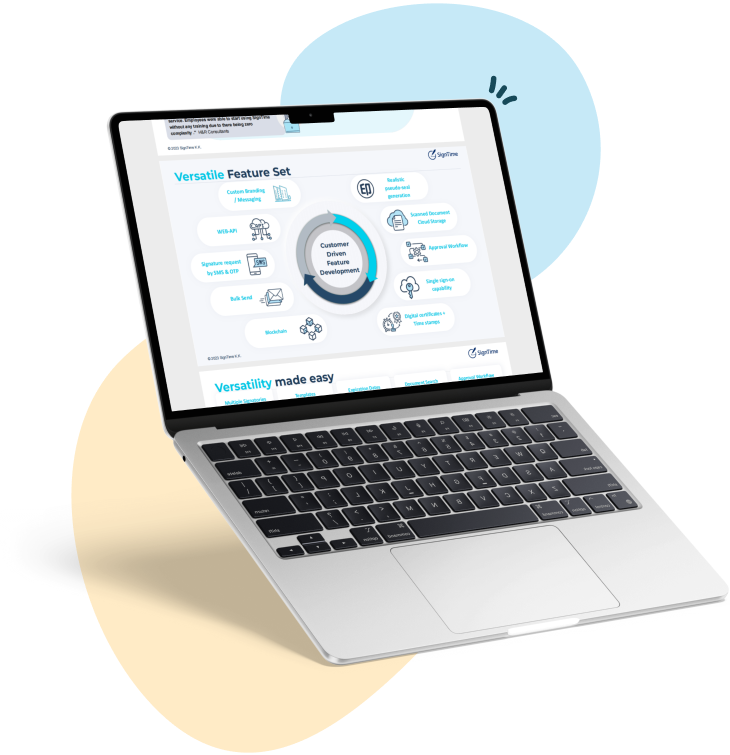
See why businesses are rushing to SignTime’s feature-packed contract repository system.
What contract workflow automation is and how it works
Contract workflow automation is a structured system that manages how contracts move through an organization from initial request to final execution and storage. Instead of relying on manual coordination through email or spreadsheets, it uses predefined rules to control routing, approvals, and status tracking.
At its core, the system defines a contract lifecycle as a sequence of steps. Each step has conditions that determine what happens next, such as who must review a document, when it should be escalated, or what triggers final approval. This creates a predictable flow that reduces dependency on individual follow-ups.
The process typically begins when a contract is created or requested through a standardized intake point. From there, the system guides the document through drafting, review, approval, and signature collection. Once executed, it moves into a repository where it can be searched, monitored, and managed over time.
Automation also introduces real-time visibility. Stakeholders can see where a contract is in the process, who is responsible for the next action, and whether any deadlines are approaching. This reduces bottlenecks that often occur when approvals are delayed or unclear.
In practice, contract workflow automation turns what is often a fragmented and informal process into a controlled operational system with traceable steps and defined responsibilities.
Why contract workflow automation matters for modern businesses
Contract workflows are often where operational friction becomes visible. Even in well-run organizations, contracts tend to move through fragmented systems involving email chains, shared drives, and informal approvals. Contract workflow automation addresses this by creating a single structured path that reduces uncertainty and manual coordination.
The main value comes from predictability. When contract steps are standardized, teams no longer rely on individuals remembering to forward documents or follow up on pending approvals. This reduces delays that accumulate when multiple stakeholders are involved across legal, finance, sales, and procurement functions.
It also improves operational control. Leaders gain clearer insight into where contracts are stuck, which teams are creating bottlenecks, and how long each stage takes. This visibility helps organizations identify inefficiencies that are otherwise difficult to measure.
Risk reduction is another important factor. Without structured workflows, contracts can be signed with missing approvals, outdated terms, or unclear version histories. Automation enforces rules that help ensure the correct review sequence is followed consistently.
Finally, contract workflow automation supports scalability. As organizations grow, manual coordination becomes increasingly difficult to maintain. A structured system allows contract volume to increase without a proportional increase in administrative overhead.
Core stages of a contract workflow
Contract workflows generally follow a repeatable sequence that moves a document from initial request through to execution and long-term management. While organizations may customize steps, most workflows share a common structure designed to ensure consistency, accountability, and traceability.
The process usually begins with contract intake. This is where a request is submitted with key details such as the contract type, parties involved, and intended purpose. Standardized intake helps prevent incomplete or inconsistent requests from entering the system.
Next comes drafting and preparation. At this stage, teams typically use templates or pre-approved clauses to create a first version of the contract. This reduces variability and helps maintain legal and operational consistency across agreements.
Review and collaboration follow drafting. Legal, finance, or other stakeholders review the contract based on predefined rules. Feedback is incorporated through controlled revisions, ensuring that changes are tracked and approved rather than made informally.
Approval routing is the next critical stage. The contract is directed to the appropriate decision makers based on criteria such as value, risk level, or department. Structured routing ensures that approvals happen in the correct order without bypassing required checks.
Once approved, the contract moves to execution. This includes collecting signatures using electronic or hybrid methods depending on organizational requirements. After all signatures are completed, the agreement becomes legally binding and is finalized.
Finally, the contract is stored and managed in a centralized repository. This stage supports searchability, reporting, and future actions such as renewals or amendments. Proper storage ensures that contracts remain accessible and usable throughout their lifecycle.
Key features of contract workflow automation systems
Contract workflow automation platforms are designed to reduce manual coordination while improving consistency and control across contract processes. They do this by combining workflow logic, document management, and tracking tools into a single system that supports the full contract lifecycle.
One of the most important capabilities is automated approval routing. Systems use predefined rules to determine who must review a contract and in what order. This reduces delays caused by uncertainty and ensures that approval chains are consistently followed.
Version control is another core feature. It ensures that all edits to a contract are tracked and stored, preventing confusion over which document is the most current. This is especially important when multiple stakeholders are reviewing or editing the same agreement.
Centralized contract repositories are also standard. These repositories allow teams to store, organize, and retrieve contracts from a single location. Search functionality and metadata tagging make it easier to locate specific agreements when needed.
Deadline tracking and renewal alerts help organizations avoid missed obligations. The system monitors key dates such as expiration or renewal windows and triggers notifications so that action can be taken in advance.
Audit trails provide transparency by recording every action taken on a contract. This includes who made changes, when approvals occurred, and how the document moved through the workflow. It supports accountability and internal governance requirements.
Integration capabilities are also essential. Many systems connect with tools like CRM platforms, storage systems, and identity management solutions to ensure that contract data flows smoothly across business systems.
Types of contract execution and signature methods
Contract execution refers to the process of collecting signatures and finalizing agreements so they become legally effective. Modern contract workflow automation systems support multiple signature methods to accommodate different legal, operational, and user experience requirements.
Electronic signatures are the most widely used method. They allow users to sign documents digitally without printing or scanning. These signatures are typically used for standard business agreements where speed and convenience are priorities.
Typed signatures are another common option. In this method, a user types their name into a designated field, and the system formats it as a signature. This approach is often used in low-friction workflows where simplicity is more important than visual replication of handwriting.
Hand-drawn signatures replicate a traditional signing experience. Users draw their signature using a mouse or touchscreen, which can help maintain familiarity in workflows that transition from paper-based processes.
Some systems also support certificate-based digital signatures. These use cryptographic validation to verify identity and ensure document integrity. They are typically used in higher-assurance environments where compliance and security requirements are stricter.
In-person signature collection is a less common but important capability in certain industries. It allows contracts to be signed during physical meetings or events while still being recorded digitally within the system. This helps bridge offline and online workflows.
Certain regions or organizations may also use culturally specific signature methods, such as seal-based authentication. These approaches are integrated where needed to support local business practices while maintaining a consistent digital workflow.
AI in contract workflow automation
Artificial intelligence is increasingly embedded in contract workflow automation systems to reduce manual review effort and improve the accuracy of contract data handling. Instead of relying entirely on human review, AI tools help identify, structure, and surface key information within contracts.
One major application is data extraction. AI can identify important contract elements such as parties, effective dates, payment terms, and obligations. This structured data makes contracts easier to search, filter, and analyze across large repositories.
AI is also used for deadline and renewal detection. By scanning contract language, systems can identify renewal clauses and trigger reminders before key dates are reached. This helps organizations avoid missed renewals or unintended auto-renewal cycles.
Another common use case is risk and anomaly detection. AI can flag unusual clauses, missing terms, or deviations from standard templates. This supports review teams by highlighting areas that may require closer attention.
Contract summarization is also becoming more common. Instead of reading full documents, users can view concise summaries that highlight the most important terms. This speeds up review cycles and reduces cognitive load for stakeholders.
Finally, AI supports classification and organization. Contracts can be automatically grouped by type, department, or purpose, which improves retrieval and reporting across large document sets.
Integration and ecosystem connectivity
Contract workflow automation becomes significantly more effective when it connects with the other systems an organization already uses. Without integration, contract data often remains isolated, which limits visibility and creates duplication of work across teams.
A common integration point is customer relationship management systems. When connected, contract workflows can align directly with sales activity, ensuring that agreements reflect the correct deal structure and customer information without manual re-entry.
Document storage systems are another key connection. Integration allows executed contracts to be automatically archived in centralized repositories, which improves accessibility and reduces the risk of files being stored in disconnected locations.
Identity and access management systems also play an important role. These integrations ensure that only authorized users can view or modify contracts, supporting security and governance requirements across the organization.
Many platforms also support API-based integrations. This allows businesses to connect contract workflows with custom internal systems or industry-specific tools, creating more tailored automation flows that match operational needs.
Calendar and notification systems are frequently integrated as well. This enables automatic reminders for key contract milestones such as renewal dates, approval deadlines, or obligation tracking, helping teams stay proactive rather than reactive.
Common challenges in contract workflow automation
Contract workflow automation improves consistency and visibility, but implementation is not always straightforward. Many of the challenges arise not from the software itself, but from how workflows are designed, adopted, and governed within an organization.
One frequent issue is overly complex workflow design. When approval chains include too many conditional steps or unclear ownership, automation can amplify inefficiencies rather than resolve them. Instead of speeding up processes, poorly designed workflows can create additional friction.
Another challenge is low user adoption. If the system feels unintuitive or adds perceived extra steps, teams may attempt to bypass it through informal channels. This undermines the value of automation and reintroduces manual risks.
Integration gaps can also limit effectiveness. If contract systems are not properly connected to CRM, storage, or identity tools, data may become fragmented. This can lead to inconsistencies between systems and reduce trust in reporting outputs.
Governance and permissions are another critical area. Without clearly defined access controls, users may either lack the ability to complete tasks or have excessive access that creates compliance concerns. Both situations can slow down workflows or introduce risk.
Finally, change management is often underestimated. Moving from manual processes to structured automation requires behavioral adjustment across legal, sales, finance, and operations teams. Without clear onboarding and training, organizations may struggle to fully realize the benefits of the system.
How to evaluate contract workflow automation software
Selecting contract workflow automation software requires looking beyond surface-level features and focusing on how well the system supports end-to-end contract operations. The right platform should reduce manual effort while remaining flexible enough to match real business processes.
A primary consideration is full lifecycle coverage. The system should support contract intake, drafting, review, approval, execution, storage, and renewal tracking within a single continuous workflow. Fragmented tools often create gaps that reduce efficiency.
Workflow configurability is also important. Organizations should be able to design approval paths and routing rules without requiring heavy technical support. If configuration is too rigid, teams may struggle to adapt the system to changing operational needs.
Integration capability plays a major role in long-term usability. The platform should connect smoothly with tools such as CRM systems, document storage, and identity management platforms. Strong integration reduces duplication of data and improves consistency across systems.
Security and compliance features should also be evaluated carefully. This includes access controls, audit trails, and data protection measures that ensure contracts are managed safely and in line with internal policies.
AI-driven capabilities are becoming increasingly relevant. Features such as data extraction, renewal detection, and contract classification can significantly reduce manual workload and improve visibility across large contract portfolios.
Finally, scalability matters. The system should be able to handle increasing contract volume and organizational complexity without requiring a complete restructuring of workflows. This ensures long-term viability as the business grows.
SignTime is the easiest way to perform contract workflow automation
Contract workflow automation works best when it reduces friction without forcing teams into rigid processes. SignTime supports this goal by combining e-signature functionality, workflow management, and contract organization in a single platform designed to adapt to different operational styles.
It supports multiple signature methods, including typed, hand-drawn, and in-person signing. This flexibility allows organizations to match signature workflows to the context of each agreement rather than relying on a single standardized approach.
The platform also supports structured contract handling from creation through execution. Teams can route documents for review and approval, track progress in real time, and store finalized agreements in a centralized repository for ongoing management and retrieval.
AI-assisted capabilities add another layer of support by helping extract key contract details, identify important dates, and surface renewal risks. These features reduce the need for manual review and help teams stay ahead of obligations without constant monitoring.
SignTime also integrates with widely used business systems such as Salesforce. This allows contract activity to align more closely with customer and deal workflows, reducing duplication and improving consistency across sales and legal operations.
At the same time, it is important to recognize that contract workflow automation tools vary in complexity and focus. Some organizations may only need lightweight e-signature capabilities, while others require deeper lifecycle management. The value of SignTime depends on how closely its features match those specific needs.
In this context, SignTime provides a balanced option for teams looking to streamline contract workflows without introducing unnecessary complexity, while still offering advanced capabilities for organizations that need them.
Download our brochure to see whether SignTime might be a fit for your organization.