release:
11 best government contract management software
Government contract management software helps organizations create, track, and control contracts across complex procurement environments. These platforms are used to manage compliance-heavy workflows, reduce manual tracking, and improve visibility into contract obligations from start to finish.
The keyword “government contract management software” reflects a category built around audit readiness, structured approvals, and lifecycle control. Modern tools in this space increasingly combine automation, AI-assisted contract analysis, and integration with systems like Salesforce and enterprise ERPs to support end-to-end contract operations.
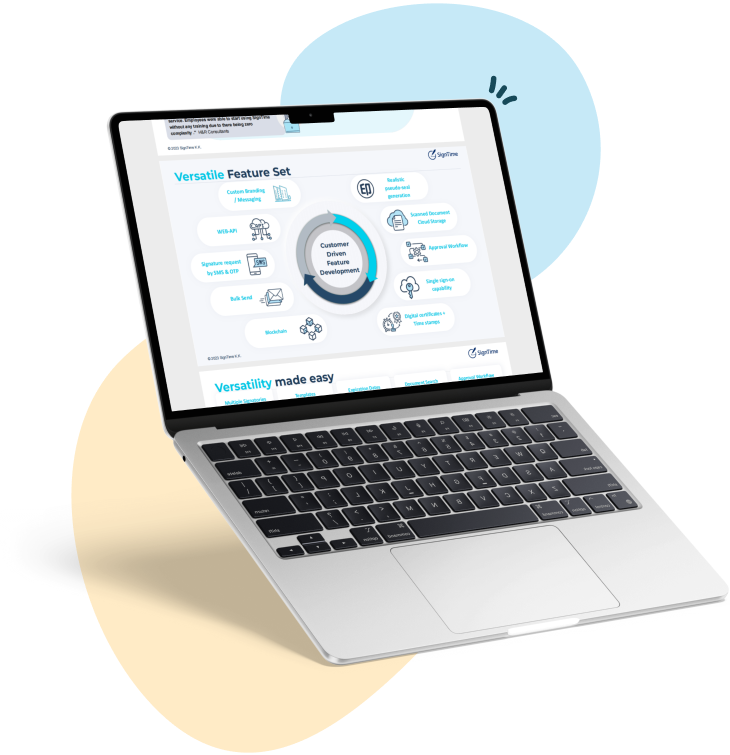
See why businesses are rushing to SignTime’s feature-packed contract repository system.
What government contract management software does in modern procurement
Government contract management software sits at the center of procurement operations where accuracy, traceability, and timing matter. It is designed to reduce manual coordination between legal, procurement, and finance teams by consolidating contract data and workflows into a single system.
These platforms typically manage contracts from initial request through execution and ongoing administration. They help ensure that obligations are tracked, deadlines are visible, and contract versions remain consistent across all stakeholders.
In practice, this category of software is used to reduce operational friction in environments where contracts are complex and highly regulated. The goal is not only storage, but structured control over how agreements are created, approved, and maintained.
Why compliance and audit readiness define this category
Compliance and audit readiness sit at the core of government contracting because contracts must be defensible under external review at any time. Government contract management software is therefore designed to preserve traceability across every stage of the contract lifecycle, from drafting through execution and amendment.
These systems typically enforce structured approval chains and maintain detailed audit logs. This ensures that every change, signature, and approval can be traced back to a responsible party with a clear timestamp.
Version control and clause management are also central to this requirement. They help organizations ensure that only approved language is used and that historical contract states can be reconstructed when needed.
Key workflows covered by contract management platforms
Government contract management software is built around a full contract lifecycle, not just storage or signing. These platforms aim to support structured movement from initial contract request through negotiation, approval, execution, and long-term management.
The workflow design usually reflects the need for control and visibility at every stage. This means that different teams such as legal, procurement, and finance interact with the same contract data but within defined permission and approval structures.
Beyond execution, many systems also focus on ongoing contract administration. This includes monitoring obligations, tracking renewals, and ensuring that contractual commitments are not missed over time.
Common workflows covered include:
- Platforms manage contract intake processes where requests are standardized and routed for review through predefined approval paths.
- Systems support drafting and negotiation workflows that allow multiple stakeholders to collaborate on contract language in a controlled environment.
- Tools provide structured approval routing that ensures contracts pass through legal, financial, and managerial review before execution.
- Platforms handle electronic execution, including multiple signature methods depending on organizational requirements.
- Systems support post-execution monitoring, including renewal tracking, obligation management, and compliance checks.
Core features used to evaluate government contract management tools
Government contract management software is typically evaluated based on how well it supports control, visibility, and automation across the contract lifecycle. Most comparison articles focus on a consistent set of functional areas that determine whether a platform can handle regulated, high-volume contracting environments.
These features are not isolated capabilities. They work together to ensure contracts are created correctly, approved properly, executed securely, and monitored after signing. The strength of a platform is often defined by how seamlessly these elements connect.
In practice, buyers look for systems that reduce manual effort while increasing traceability. Integration, automation, and compliance support tend to separate basic tools from enterprise-grade platforms.
Key features commonly used in evaluations include:
- Platforms support end-to-end contract lifecycle management that connects intake, drafting, approval, execution, and renewal in a single workflow.
- Systems provide detailed audit trails that record every action taken on a contract, including edits, approvals, and signatures.
- Tools integrate with enterprise systems such as Salesforce and ERP platforms to ensure contract data flows across business functions.
- Platforms include role-based access controls that restrict sensitive contract data to authorized users only.
- Advanced systems use AI to extract key contract data such as dates, parties, obligations, and financial terms automatically.
Market trends shaping government contract management software
Government contract management software is evolving from a document storage tool into an operational intelligence layer for procurement and compliance. Recent market analysis shows that AI is becoming a foundational architecture rather than an optional add-on, reshaping how contracts are created, reviewed, and monitored across organizations.
A major shift is the move toward AI-native systems that embed automation directly into core workflows. Instead of assisting only at the review stage, these systems now extract contract data, trigger downstream actions, and connect contracts to broader business systems like ERP and CRM platforms.
Another defining trend is the growing importance of post-signature management. While earlier tools focused heavily on drafting and negotiation, newer platforms emphasize obligation tracking, renewal management, and continuous compliance monitoring as the primary source of value.
Interoperability is also becoming a baseline expectation. Organizations increasingly require contract platforms that integrate seamlessly across finance, procurement, and legal ecosystems, rather than operating as isolated repositories.
Key trends include:
- Platforms increasingly embed AI into core contract workflows rather than treating it as an add-on feature, enabling automated extraction of key terms and faster processing cycles.
- Systems are shifting focus from pre-signature activity toward post-signature value, including obligation tracking, compliance monitoring, and renewal optimization.
- Integration with ERP and CRM systems is becoming standard, allowing contract data to flow directly into operational and financial systems.
- Contract data is being treated as structured business intelligence rather than static documentation, enabling reporting and decision support.
- Regulatory and audit requirements are pushing platforms toward stronger traceability, governance, and system-wide transparency.
11 best government contract management software
Government contract management software spans enterprise CLM platforms, procurement systems, and e-signature-integrated workflows. Most rankings emphasize compliance strength, workflow automation, ERP integration, and audit readiness as the key decision factors. Many also highlight the growing role of AI in obligation tracking and contract analytics.
The tools below reflect what consistently appears across current industry rankings and procurement-focused reviews. They vary in depth, from full enterprise governance platforms to more execution-focused CLM systems.
Here are the best contract management software options for government organizations:
- SignTime
- Deltek Costpoint
- Unanet
- Icertis Contract Intelligence
- DocuSign CLM
- Agiloft Contract Lifecycle Management
- Ironclad
- SAP Ariba Contracts
- Coupa Contract Management
- Conga Contracts
- Oracle Procurement Contracts
SignTime
SignTime is an e-signature and contract management platform that combines contract execution with structured lifecycle management. It supports multiple signing methods, including typed, hand-drawn, and in-person signatures, which allows flexibility across different operational environments.
It integrates contract workflows with a centralized repository. This helps teams move from drafting and approval into execution and storage without switching systems.
SignTime also includes AI-assisted contract intelligence. It can extract key terms such as parties, dates, amounts, and obligations to reduce manual review work.
It supports renewal tracking and automated reminders for contract milestones. This helps organizations maintain visibility over expiring agreements and ongoing obligations without relying on manual tracking.
Deltek Costpoint
Deltek Costpoint is widely used in government contracting environments where project accounting and compliance tracking are central requirements. It connects contract data with financial and operational project management.
It is particularly strong in regulated industries that require detailed cost tracking and reporting. The system is often used in defense and public sector contracting workflows.
Unanet
Unanet combines ERP functionality with contract and project management tools. It is commonly used by government contractors who need to align labor, financials, and contract obligations in one system.
Its strength lies in connecting contract commitments directly to project execution. This improves visibility across operational and financial performance.
Icertis Contract Intelligence
Icertis is an enterprise-grade contract lifecycle management platform focused on governance and compliance. It is designed for large organizations with complex contracting portfolios.
The platform uses AI-driven contract intelligence to identify obligations, risks, and compliance requirements. It is often deployed in highly regulated environments.
DocuSign CLM
DocuSign CLM extends e-signature functionality into full contract lifecycle management. It supports drafting, negotiation, approval workflows, and execution in a unified system.
It is widely adopted due to its integrations and usability. Many organizations use it as an execution layer connected to broader procurement systems.
Agiloft Contract Lifecycle Management
Agiloft is a highly configurable CLM platform designed for organizations that need customizable workflows. It supports automation across approval routing, contract creation, and compliance tracking.
Its flexibility makes it suitable for organizations with evolving or complex internal processes. It is often selected for its adaptability.
Ironclad
Ironclad focuses on legal-centric contract workflows with strong collaboration features. It supports structured drafting, negotiation, and approval processes.
It is known for its workflow automation capabilities and user-friendly interface. Legal and procurement teams often use it together.
SAP Ariba Contracts
SAP Ariba Contracts is part of the broader SAP procurement ecosystem. It is designed for large enterprises managing procurement-heavy contract environments.
It integrates closely with ERP and supply chain systems, enabling centralized control over sourcing and supplier agreements.
Coupa Contract Management
Coupa Contract Management focuses on spend visibility and procurement optimization. It connects contract data to sourcing and financial workflows.
It is often used to improve control over supplier agreements and procurement compliance.
Conga Contracts
Conga Contracts integrates tightly with CRM systems to support contract generation and lifecycle tracking. It is commonly used in sales-driven organizations.
It emphasizes automation for contract creation, approval routing, and renewal management.
Oracle Procurement Contracts
Oracle Procurement Contracts is designed for organizations already using Oracle ERP systems. It supports procurement-driven contract creation and governance.
It integrates contract workflows with financial and procurement modules for centralized oversight.
SignTime is the best government contract management software
SignTime brings contract execution, management, and intelligence together in a single system. It is designed to support organizations that need structured control over agreements without separating signing, storage, and lifecycle tracking into different tools.
The platform combines flexible e-signature options with contract repository functionality. This allows teams to move from document creation to approval and execution while keeping contract data centralized and consistent.
SignTime also applies AI to practical contract workflows. It can extract key contract details such as parties, dates, and financial terms, which reduces manual review effort and improves visibility across contract portfolios.
Beyond execution and analysis, SignTime supports ongoing contract oversight. Features like renewal detection and automated reminders help organizations track obligations and upcoming deadlines in a structured way.
At the same time, SignTime remains focused on contract management and e-signatures rather than legal advisory or notary services. This keeps the platform centered on operational workflow rather than interpretation or legal decision-making.
Download our brochure to see whether SignTime might be a fit for your organization.